
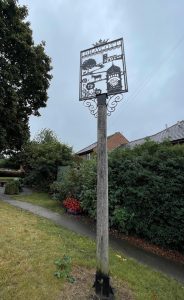
THE QUIET STREETS
It’s a long journey from Dorset to Cleethorpes, and we’re not as young as we used to be. Over the years, the journey has taken anything from 5-8 hours, depending on how bad the traffic is and how many roadworks we come across on the way.
A couple of years ago we started to break the journey, stopping at different places on the way, to stretch our legs and get a change of scenery. On a recent trip north, we made a detour to Draycott in Derbyshire, where my husband spent the early part of his childhood.
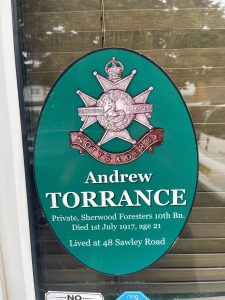
We stopped the car on Sawley Road and walked down to the terraced house where his grandparents lived. While Mr B wandered around, his head full of memories, I was drawn to a plaque in a nearby window. Naturally curious (don’t you think that sounds much nicer than nosey?) I went to take a closer look, thinking it was an award for something.
What I found was totally unexpected and led me on a journey that I’ll always remember – for all the right reasons.
REMEMBERING THE FALLEN
The green oval plaque mentioned the young man who had lived there, Andrew Torrance, who had joined the army during the conflict of the Great War 1914-1918. He served as a private in the 10th Battalion of the Sherwood Foresters. He died on 1st July 1917, aged 21.
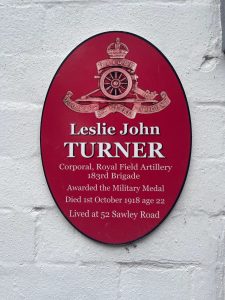
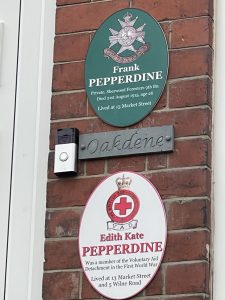
As we drove around, I noticed more and more of these plaques in windows, on gate posts or fixed on the wall at the side of the door. Some had two, some red, some green. Each one bore the name of the young man who had lived at that address, their name, their regiment, rank, the date and the age they were when they were killed.
One I came across said ‘returned home’. There was joy reading that one. So many were lost, but many survived – although they would have had their own scars to bear, mental as well as physical.
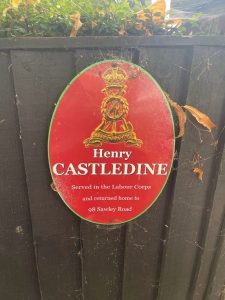
THE WHITE OVALS OF SOUTH STREET
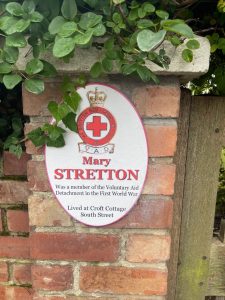
We stopped the car again, looking for the small one-up-one-down cottage where Mr B had lived with his parents. It was no longer there, a large detached house in its place. As he tried to picture his childhood home, on a gatepost, further down the road, I saw another of the plaques. This time it was white.
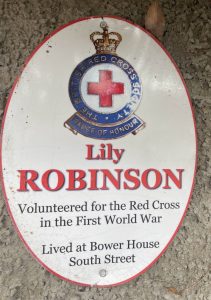
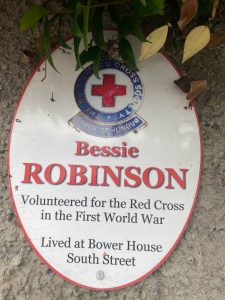
On it was the name of a young woman, Mary Stretton, who had volunteered with the Voluntary Aid Detachment (VADS) during the conflict. Further down the same street were two more, the Robinson sisters Bessie and Lily, who had served with the Red Cross. All three lived a few yards from each other. I wondered whether they had volunteered together, or had gone separately.
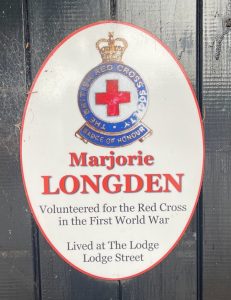
More than a trip down memory lane
What was initially a trip down memory lane became something much deeper as I searched for more plaques.
It’s quite something to stand on a street and see the red and green ovals marking the doorways, to see how many homes were affected, how many loved ones didn’t return, never walked through that door again. It’s a marvellous visual representation of how war impacted a town, a neighbourhood. I found it enormously moving.
I later discovered that the project was arranged by the Draycott and Church Wilne History Group. They also produced a map giving the names of those who died, those who returned, the Red Cross Volunteers, and the Voluntary Aid Detachment. It’s a wonderful project, a moving way to remember the fallen, and I’m so glad we made that detour.
If you’re ever travelling down the M1 I can highly recommend it.