
ULVERSCROFT INTERVIEW – TRACY BAINES
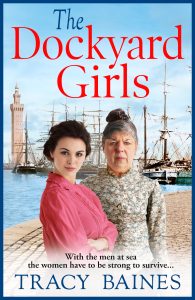
This was an interview I did with publisher Ulverscroft when they recorded the audio version of The Dockyard Girls. I thought I’d share it here because it gives insight into the background and the inspiration behind the series. You’ll find a link at the end of the article, which gives a sample of the audio version, narrated by Catherine Harvey.
What inspired the story behind The Dockyard Girls?
The stories my grandmother told me were the inspiration for The Dockyard Girls (which was first published as The Women of Fishers Wharf). When I was a child, she told me the biggest shock of her life was when her brother Alf was lost at sea when he was skipper of the trawler Leicestershire in 1938. The second was when her husband was killed in 1941, leaving her a widow with two young children. After that, she told me the shocks didn’t seem terrible. She worried that people wouldn’t know how hard life was back then and that if someone didn’t write them down, they would be lost forever. I promised her that I would. It took me a long time, and many conversations with uncles and great-uncles who were also skippers, to gather stories that became the inspiration for the book.
Introduce us to Letty. What’s facing her at the start of the book?
Letty is from a close-knit farming family. She’s used to large gatherings around the farmhouse table, everyone pitching in, caring for the animals and going out in all weathers, so she’s not afraid of hard work. However, she is shocked when she moves to Grimsby and realises that her new husband will be away at sea for three or more weeks at a time and she’ll be left with her mean-spirited mother-in-law.
What’s your favourite quality about her?
Her kindness and her strength. I love the way she’s not afraid to take risks and put in the hard work, not expecting things to work out as she might want, but having a go anyway. I wish I’d been more like that in my own life.
If you could offer her any advice, what would it be?
Take time to smell the roses. But I suppose she’ll do that as she gets older.
Tell us about the setting of Grimsby.
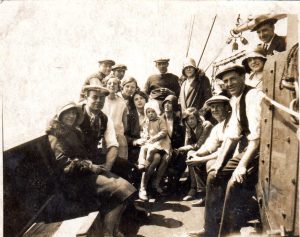
Grimsby was once the largest fishing port in the world. When I was born, it was already in decline, but at the beginning of the 20th century the dock area was a thriving industry, and many subsidiary businesses prospered because of it. People flocked there from all over the country to make the most of opportunities as the town grew. The most prominent feature that still exists is the Dock Tower. It must have been a glorious sight to see when you’d been tossed about in stormy seas for weeks on end.
If you had a day to show us around, where would you take us?
Our first port of call would be the Fishing Heritage Centre to get a fantastic insight into what Grimsby was like for men on board trawlers over the years. They lived and worked in such dangerous and arduous conditions. We would step aboard the trawler Ross Tiger and get a guided tour from an ex-fisherman. Nothing can replace the value of getting such detail from the people who’ve lived that life.
I’d then take you to the Fishermen’s Chapel in Duncombe Street where the altar and stained glass windows are preserved from the Bethel Mission (which features in the book). Although Freeman Street is much changed, I think I could paint a pretty good picture of what it was like in its heyday. We’d stop for refreshment at Docks Beers, which is housed in an old church in the area where Letty lives when she first arrives in Grimsby.
And then onto the docks. Not many of the original buildings remain, but there is a fabulous heritage project going on at the moment, and what is left will be preserved. Last stop would be Alfred Enderby fish smokers, so you could take home a little bit of Grimsby. You can’t leave without taking a lovely bit of fish with you.
How do you go about researching the historical settings behind your books?
I have maps and numerous books that I’ve collected over the years. Others I’ve borrowed from the library. In fact, the first part of my research began many years ago in the reference department of Grimsby Library. I would read the newspapers on microfiche – yes, that long ago – there were no personal computers then. I discovered articles relating to the time my great-uncle’s ship was lost at sea, reports of the bodies being returned from the Orkneys and the funeral service. It was all very moving and stayed with me my whole life.
Do you have a favourite historical period to write about?
I suppose I favour the first half of the twentieth century. The effect on the population during both the Great War and World War II fascinates me, as does the period between the wars when people were trying to rebuild a future after so much pain and loss.
How important is it that your books will be available in audio as well as traditional formats?
Incredibly important. It makes books hugely accessible for those with sight problems or reading difficulties. The pleasure of discovering a good story is available to a wider audience because of it. I know many people listen while travelling and walking – I do so myself. I find being read to incredibly soothing
Did your narrator Catherine Harvey bring anything to The Dockyard Girls you weren’t expecting?
I found it fascinating to listen to Catherine read The Dockyard Girls; she really brought the characters alive for me, and I saw them in a different light. I think it’s amazing what a professional actor can bring to a book. I love the warmth of her voice, and listening to her made me remember how strong people were years ago.
How important are libraries for an author?
Hugely important; in fact, I’d go so far as to say I wouldn’t be a writer without having had access to libraries. I must have borrowed thousands of pounds worth of books over the years. I will never forget my joy as a child when I discovered I could borrow three books at a time – and every day if I wanted to – which I did many times.
I use my local library regularly, and when I’m home in Grimsby and Cleethorpes I try and cram in as much research as I can – and I’m still reading those old copies of the local newspaper on microfiche!
What’s next for the fisherfolk of Grimsby?
The Great War looms; the younger fishermen take to the minesweepers and the older men keep fishing. They were incredibly brave, and some of the research I’ve done is harrowing. They fought, but they also fished to keep the nation fed. Letty will be building her business assets, and the women will be pulling together as they always did.

Listen to a preview of The Dockyard Girls
Can you leave the past behind and embrace the future?
Great Grimsby, 1912
Newlywed fisherman Alec Hardy decides to make a fresh start with his young wife Letty and move to the thriving fishing port of Grimsby in search of a brighter future.
Letty is from farming stock and knows nothing of the hard life as a fisherman’s wife but is willing to embrace the challenge with Alec.
But where Alec goes, so does his widowed mother, Dorcas, and she has trouble coming to terms with taking second place in her son’s life.
With Alec at sea for weeks on end, the two women clash, and Letty seeks escape from her bitter mother-in-law amongst the streets of Fishers Wharf.
Can Letty help them break free from the shadows of the past, or will she be bound by Dorcas’ insistence that they cling to the old ways?